⚠️

Critical Alert: PFAS have been detected in the groundwater of landfills in all 50 states. The EPA has designated PFOA and PFOS as hazardous substances under Superfund. Every day we continue burying waste is another day of compounding liability — for municipalities, landowners, and the communities living nearby.

The Crisis

PFAS: The Next Asbestos

Per- and polyfluoroalkyl substances — PFAS — are a class of over 12,000 synthetic chemicals that do not break down in the environment or in the human body. They are found in firefighting foams, nonstick cookware, waterproof clothing, food packaging, cosmetics, and industrial discharge.

As municipal landfills decompose organic matter, they release PFAS into the air through vented gases and into groundwater through liquid leachates. Scientists have measured PFAS at some landfill sites at levels in the tens of thousands of parts per trillion — many times above the EPA's 4 ppt drinking water limit.

Experts estimate that every year 16,500 pounds of PFAS enter US landfills. Of that, approximately 1,100 pounds are released as air pollution and 1,760 pounds escape through leachate into drinking water. The buried toxic sludge underneath America's communities is not staying buried.
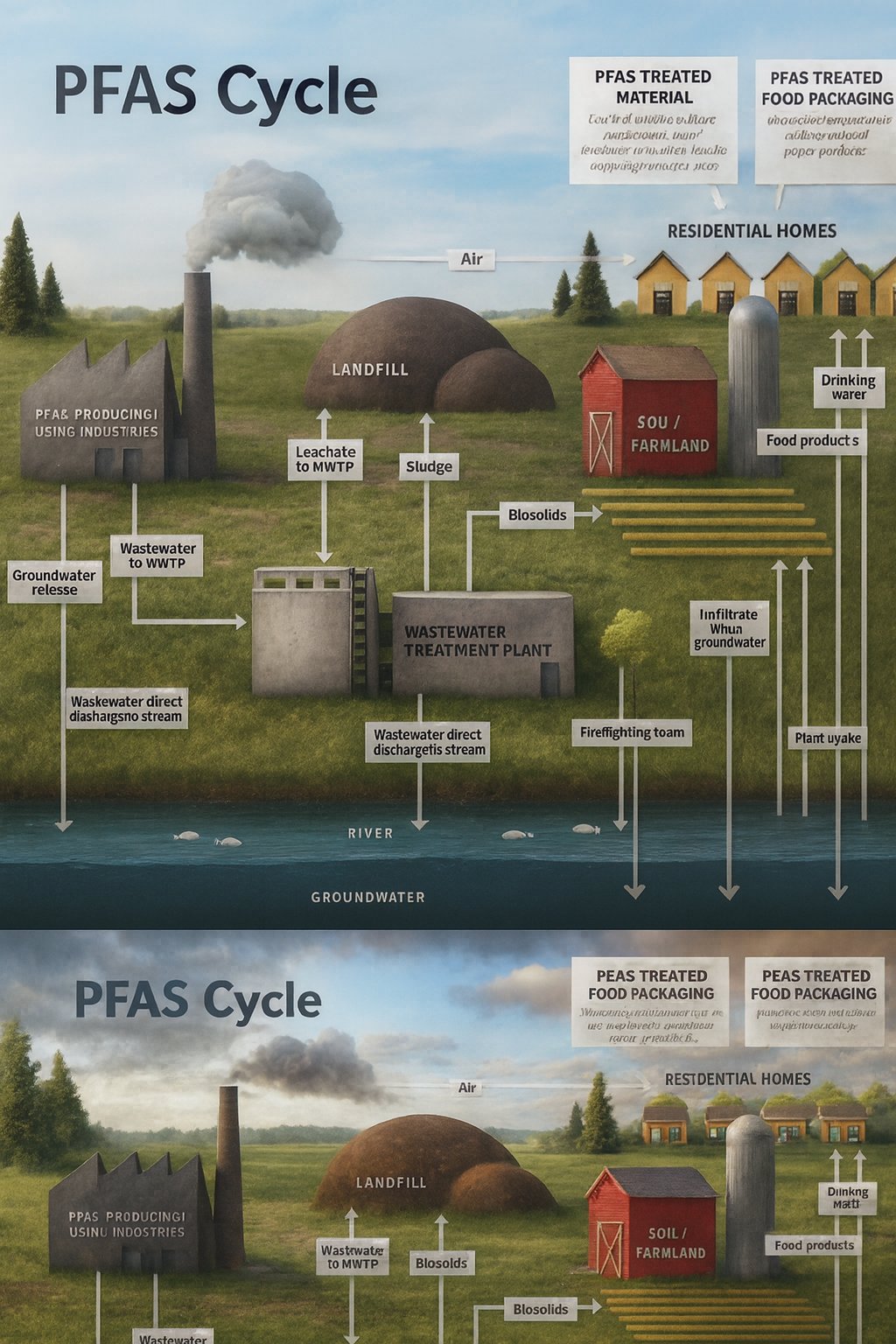
PFAS Cycle — how forever chemicals move through the environment

The PFAS cycle: from manufacturing and landfills through wastewater treatment, biosolids, and into soil, groundwater, and the food supply.

PFAS Contamination Across America

Minnesota

PFAS found in 100 closed landfills — 16 sites at 10× above state drinking water standards.

New Hampshire

135 of 174 sampled landfills (77.5%) had PFAS in groundwater above state standards.

Vermont

Elevated PFAS found in the leachate of every single landfill tested.

California

84 sampled landfills contained PFAS in leachate — some sites at tens of thousands ppt.

Michigan

93 landfills identified where PFAS have been detected in groundwater.

Washington

Elevated PFAS found in 17 of the landfills sampled statewide.

New York

PFAS found above state standards in the groundwater of 70% of inactive landfills surveyed.

Maine

Decades of sludge-based fertilizer application contaminated farms — milk, meat, and drinking wells. "A nightmare you can't wake up from." — ME DEP Commissioner

⚕️ Known Health Effects of PFAS Exposure

Increased risk of kidney and testicular cancer

Elevated cholesterol and cardiovascular risk

Changes in liver enzymes and immune function

Decreased vaccine response in children

High blood pressure and preeclampsia in pregnancy

Decreased birth weight and developmental delays
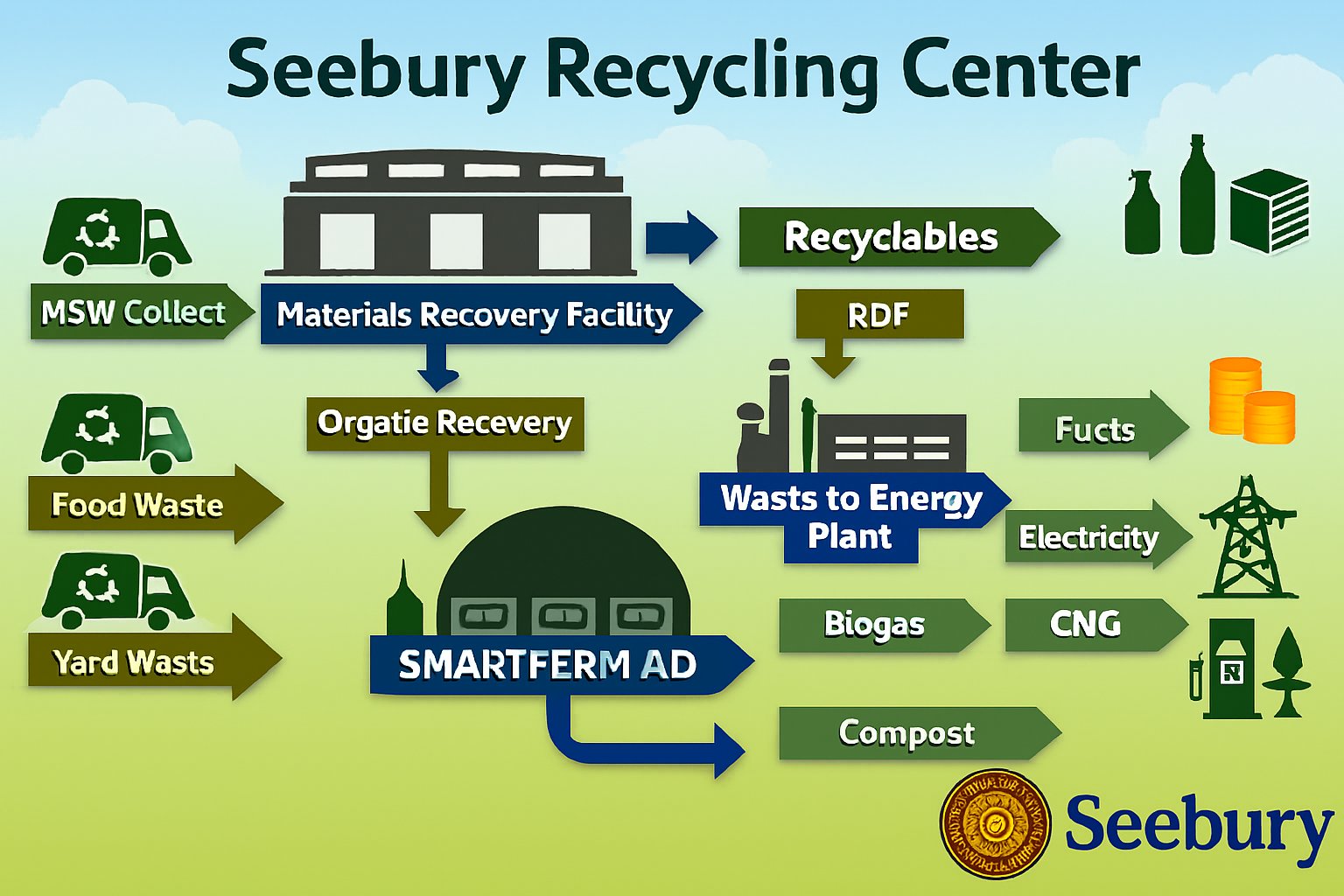
Seebury Recycling Center

The Full Circular System — From Collection to Energy

Every ton of waste that enters a Seebury Recycling Center exits as something useful — recyclable materials, electricity, compressed natural gas, or compost. Zero landfill. Zero buried liability.

Seebury Recycling Center — Full system diagram showing MSW, Food Waste and Yard Waste flowing through the Materials Recovery Facility, SMARTFERM AD anaerobic digester, and Waste-to-Energy Plant to produce Recyclables, Electricity, CNG, and Compost
🚛
INPUT
MSW · Food · Yard Waste
🏭
SORT & RECOVER
Materials Recovery Facility
⚗️
DIGEST
SMARTFERM Anaerobic Digestion
🔥
GASIFY
Pyrolytic Gasification · WTE Plant
⚡
OUTPUT
Electricity · CNG · Recyclables · Compost
How It Works

Pyrolytic Gasification: 40 Years of Proven Technology

Seebury's Waste-to-Energy facilities deploy proven pyrolytic gasification combustion technology through our engineering partners — Consultech, Enviropower, and Babcock & Wilcox. Rather than simple incineration, our multi-stage process converts municipal solid waste into syngas, then burns that syngas at up to 2,300°F to drive steam turbine generators — with a capacity factor of 93% and near-continuous 24/7/365 operation.

1
Step 1

Waste Receiving & Conditioning

Raw waste — municipal solid waste, biomass, medical waste, tires, construction debris — enters the enclosed receiving facility. Bulky items, electronics, and hazardous materials are removed. The balance is shredded, sorted through automated recycling machinery, and staged as conditioned feedstock. Metals and glass are removed for recycling. Approximately 7% of the waste stream never reaches the gasifier — it is recovered and repurposed first.

2
Step 2

Syngas Creation — Pyrolytic Gasification

Conditioned feedstock is introduced into the primary pyrolytic gasification chamber. At temperatures above 800°C and with tightly controlled oxygen levels, the waste undergoes dehydration, pyrolysis, and gasification — converting organic material into syngas (synthesis gas) composed primarily of carbon monoxide, hydrogen, and hydrocarbons. A small amount of inert, vitrified ash — roughly 5% by volume, resembling sand — drops into a water-cooled auger for safe disposal or reuse as road base or aggregate.

3
Step 3

Syngas Combustion — 2,300°F Secondary Chamber

Syngas flows from the primary chamber through a patented thermostack into the secondary combustion chamber, where it is burned at temperatures approaching 2,300°F. This extreme heat completely oxidizes VOCs, dioxins, and furans. The resulting energy is captured by a Heat Recovery Steam Generator (HRSG), producing superheated steam. Flue gases then pass through a full Air Quality Control train — dry scrubbers, activated carbon for mercury control, fabric filter bag houses, and selective catalytic reduction for NOx — meeting or exceeding all EPA emissions standards.

4
Step 4

Power Production — Steam Turbine Generation

Superheated steam from the HRSG drives a steam turbine-generator, producing mission-assured electricity on-site. Turbine exhaust steam is condensed, collected, and pumped back through the deaerator and HRSG for reheating — a closed-loop system. The facility operates 24/7/365 with approximately 2 days per month of scheduled maintenance downtime. Start-up from cold is approximately 90 minutes; shutdown takes about an hour. System capacity factor: 93%.

93%
Capacity Factor
40yr
Facility Useful Life
5%
Ash Volume (Inert, Reusable)
24/7
Continuous Operation
2,300°F
Combustion Temp
Organic Stream

SMARTFERM AD: Turning Organics into Fuel

Food waste and yard waste don't belong in a gasifier — they belong in a SMARTFERM Anaerobic Digestion system. The SMARTFERM AD process takes the organic fraction of the waste stream and, without oxygen, breaks it down biologically into two high-value outputs: biogas and compost.

Biogas produced in the SMARTFERM unit is upgraded to Compressed Natural Gas (CNG) — a vehicle-ready fuel used to power the collection trucks that brought the waste in the first place, closing the energy loop. The remaining digestate is processed into rich compost, returning nutrients to agricultural land safely and productively.

This is not waste disposal. This is biomass valorization — extracting maximum value from every organic pound while eliminating the methane emissions and leachate risk of landfill decomposition.

🌿

Inputs

Food waste from restaurants, grocers, and households. Yard waste — grass, leaves, woody material. Organic fraction separated at the Materials Recovery Facility.

⛽

Biogas → CNG

Anaerobic digestion produces methane-rich biogas, upgraded to pipeline-quality CNG — powering fleet vehicles, generating on-site electricity, or feeding the regional gas grid.

🌱

Digestate → Compost

The solid material remaining after digestion is processed into certified compost — nutrient-rich, PFAS-free, and ready for agricultural or landscape application. Soil restored, not contaminated.

Our WTE Partners

World-Class Engineering Behind Every Eco Campus

Seebury's Eco Campus deployments are backed by three specialized WTE engineering partners — each bringing deep technical capability across the full spectrum of waste conversion, combustion, and power generation.

WTE Partner

Consultech

Consultech provides the core process engineering for Seebury's Eco Campus deployments — specializing in advanced waste-to-energy conversion systems including pyrolytic gasification, industrial incineration, and syngas power generation. Consultech matches every waste stream profile to the optimal conversion technology, delivering the engineering precision that community-scale and utility-scale WTE projects demand.

Pyrolytic Gasification Process Engineering Municipal Scale
WTE Partner

EnviroPower Renewable (EPR)

4 GW Built · 120+ Years Experience · LoNOx™ Patented Rotary Kiln Gasification

EPR is Seebury's primary WTE technology and development partner — a privately held company formed to develop, own, and operate large-scale waste-to-energy and waste-to-liquid fuel facilities. EPR's senior team collectively carries 120+ years of experience and has designed, constructed, or operated over 20 projects totaling approximately 4 gigawatts across the US and Europe, including three operating WTE plants.

Rotary Kiln LoNOx™ Gasification: EPR's patented LoNOx design — manufactured by Metso with full performance guarantees — operates sub-stoichiometrically, producing dramatically less particulate matter, NOx, and VOCs than incineration. Stack emissions test at just 3–15% of EPA Subpart Eb limits under worst-case conditions. 700+ rotary kiln plants worldwide; 30+ WTE-specific installations. A 1,300 TPD unit (4 rotary kilns) generates ~48 MWe. Dual-unit 3,000 TPD configuration (8 kilns) scales to full regional capacity.

Plastics & Biomass to Liquid Fuel (Synergy World Power): EPR's wholly owned subsidiary converts biomass and plastic waste to ultra-low sulphur diesel and sustainable aviation fuel (SAF) via pyrolysis and hydrothermal liquefaction. Cool Plasma Catalyzed Pyrolysis processes medical waste with zero air emissions.

Business model: EPR gets paid (tipping/gate fees) to receive feedstock — eliminating input fuel cost and enabling 70% EBITDA. Five revenue streams: electricity to grid · tipping fees · by-products (char, sintered ash, graphene feedstock) · carbon credits · ultra-low sulphur renewable fuels. Each 100 jobs at an EPR facility generates 290 additional skilled trade positions in the surrounding community.

Rotary Kiln Gasification LoNOx™ Patented Plastics to SAF & Diesel Metso OEM Guarantee 70% EBITDA 3–15% of EPA Limits
WTE Partner

Babcock & Wilcox

With 155+ years of engineering experience and 650+ waste-to-energy plants supplied worldwide, Babcock & Wilcox's Renewable Energy segment brings Seebury proven Vølund™ combustion systems, biomass-to-energy technology, and carbon capture capability. B&W covers Seebury's large-scale and utility-grade WTE needs — and is currently executing a $2.4 billion AI data center power project, directly aligning with Seebury's vision of waste-powered AI infrastructure.

Utility Scale Vølund™ Systems AI Data Center Power

"Waste-to-energy plants produce electricity with less environmental impact than almost any other source of electricity."

— United States Environmental Protection Agency
The Seebury Solution

The Eco Campus: Centralized, Safe, Circular

Seebury's Eco Campus is a centralized waste processing and recycling center designed to safely handle everything a community or industrial operation discards — converting up to 90% of landfill-bound waste into new products, energy, or reusable materials. No more burying. No more hoping.

"It's a new pathway — cradle-to-cradle instead of cradle-to-grave — for how we make and consume."
— Rochester Institute of Technology, Golisano Institute for Sustainability
♻️

Plastic Recovery & Reprocessing

Plastics are sorted and reprocessed into new plastic materials or converted to synthetic fuels — eliminating ocean-bound and landfill-bound plastic waste at the source.

📄

Paper & Fiber Recycling

Paper, cardboard, and fiber materials are sorted and returned to the manufacturing cycle — preserving the embodied energy of every ton processed.

🌿

Biomass & Organic Digestion

Woody biomass, yard waste, food waste, and organics are anaerobically digested to produce renewable natural gas for community or grid use.

🔥

Pyrolysis & Incineration

Residual materials that cannot be recycled are processed through pyrolysis or incineration, generating electricity or synthetic fuels with zero landfill output.

⚗️

PFAS Destruction

Sludge and biosolids containing PFAS are processed at the Eco Campus using high-temperature incineration — the only proven method to permanently destroy PFAS compounds rather than transfer them to groundwater.

📡

24/7 Air & Water Monitoring

All air and water discharges are continuously monitored to maintain full EPA compliance. Every Eco Campus operates to the highest environmental standards — not the minimum.

Agriculture at Risk

PFAS on US Farmland: A Growing Crisis

For decades, treated sewage sludge — called biosolids — was spread on American farm fields as fertilizer. It was considered safe, even beneficial. We now know that sludge was contaminated with PFAS, and those chemicals have worked their way into soil, crops, livestock, and drinking water wells.

In Maine, farmers began finding high PFAS levels in milk and meat. Several were forced to shutter their operations entirely. The Maine Department of Environmental Protection described the situation as "a nightmare you can't wake up from." Maine is not alone — approximately half the sewage sludge produced in the US is made into fertilizer, and since 2016, an estimated 19.1 billion pounds of sludge have been applied to American farm fields.

"These forever chemicals cause harm to human health at very, very low concentrations — to the point where there is no safe concentration of PFAS. The logical thing to do is just not spread it all over the place."

— Laura Orlando, Just Zero

Seebury's Eco Campus solution brings all sludge and biosolids to a centralized facility for safe processing. High-temperature incineration permanently destroys PFAS — protecting farmland, groundwater, and the communities that depend on both.

🌾 The Scale of the Problem

EWG estimates that up to 20 million acres of US cropland — 5% of all crop fields — have received PFAS-contaminated biosolids as fertilizer. The contamination varies unpredictably: high PFAS in corn stalks but not kernels; in lettuce but not potatoes. The data are still being written.

💧 Groundwater Contamination

Seven of 34 land application sites tested in Vermont showed PFAS levels above state groundwater standards. Similar findings have emerged across New England, the Midwest, and mid-Atlantic states. Once in the groundwater, PFAS do not leave on their own.

🏭 The Seebury Answer

All biosolids and sludge brought to a Seebury Eco Campus are processed using pyrolysis or incineration — the only technologies capable of permanently destroying PFAS compounds rather than simply relocating the contamination risk.

Regulatory & Legal Landscape

The Policy Environment is Accelerating

National Drinking Water Standard

In April 2024, the EPA issued the first-ever national drinking water standard for PFAS — setting enforceable limits for six PFAS compounds. Municipalities are now legally obligated to test and remediate.

Superfund Hazardous Substance Designation

PFOA and PFOS have been designated as hazardous substances under CERCLA (Superfund). Landfills with significant PFAS contamination now face the prospect of Superfund site designation — and all the cost and liability that entails.

RCRA Proposed Rules

Proposed Resource Conservation and Recovery Act regulations would add PFAS to the list of hazardous constituents — dramatically expanding cleanup obligations for industrial facilities, landfill operators, and wastewater treatment plants nationwide.

⚖️ The Litigation Wave Has Already Arrived

PFAS litigation has become one of the largest environmental legal battles in US history. 15,000+ claims have been filed nationwide against PFAS manufacturers. Companies including 3M, DuPont, Chemours, and Corteva have already paid $11.5B+ in damages — with more to come as additional states file suit and Superfund designations multiply.

Municipalities, counties, and industrial operators that continue landfill-based waste disposal face compounding legal exposure as PFAS regulations tighten and litigation expands. The time to act — and to partner with Seebury — is now.

The Convergence Opportunity

AI's Energy Crisis Is
Waste's Biggest Opportunity.

The same technology that cleans up our landfills, destroys PFAS, and powers our communities may be the only renewable energy source capable of meeting the insatiable energy demands of artificial intelligence — at scale, continuously, and without fossil fuels.

20%
Projected US electricity demand growth by 2030 — driven by AI
8%
Share of all US energy consumed by data centers by 2030 — Goldman Sachs
50%
Of AI power needs that could be met by US landfill waste energy alone — Kore Infrastructure
2,600
US landfill sites whose waste streams could become clean energy feedstock

The Grid Cannot Keep Up.

Goldman Sachs projects that incremental data center power consumption will drive 3.3 billion cubic feet per day of new natural gas demand by 2030 — requiring new pipeline capacity across the country. Microsoft and OpenAI alone are planning a $100 billion data center requiring five gigawatts — roughly five nuclear reactors.

Google's emissions jumped 48% from 2019 to 2023. Microsoft's rose 29%. Meta's soared 66%. The tech giants' sustainability commitments are being overwhelmed by AI's appetite. Wind and solar, valuable as they are, cannot provide the continuous, non-periodic baseload that data centers require around the clock.

Waste-to-energy is different. It runs 24/7. It doesn't depend on sun or wind. It converts a liability — the waste stream — into an asset. And it is available in every community on Earth.

Seebury's Answer: The AI Eco Campus.

At Seebury, we see waste not as a disposal problem but as a feedstock. The same Eco Campus Recycling Center that processes a community's municipal solid waste, food waste, and yard waste can generate the electricity and cooling needed to power an AI data center right next door.

The offtake for this green power is the data center itself. The data center gains mission-assured, continuous, renewable baseload power. The community gains a clean waste solution. The landfill stops leaching PFAS. And methane — 25 times more harmful than CO₂ — gets captured and converted to electricity instead of vented into the atmosphere.

"AI — one of the greatest technological achievements of mankind — may be the inadvertent force that enables us to save our planet."

— Arick Wierson, Newsweek

Global demand for the waste streams needed to power the AI revolution could inadvertently set up the market economics needed to address global warming at scale — transforming massive centers of waste production like Mumbai, Manila, and Mexico City into the energy hubs of the future.

Seebury is positioned at the exact intersection of this convergence — building the Eco Campus solutions that pair waste processing with AI data center energy requirements. Contact Seebury to explore an AI Eco Campus for your community, region, or data center project.

International Reference

WTE at the Island Scale

Seebury's WTE model was designed from the beginning to work wherever waste is a crisis — from rural American communities to small island nations with no land to spare.

150 TPD 7 MW Output Public–Private Partnership

Republic of Maldives — City of Malé

Indian Ocean · 150 TPD Pyrolysis WTE · Seebury–Enerbay Consortium

The Maldives WTE proposal demonstrates Seebury's model at its most essential: a small island nation with zero land to spare, a growing landfill crisis threatening marine tourism, and total dependence on diesel generation. Seebury proposed a 150 tons-per-day pyrolysis waste-to-energy facility sized to deliver 7 megawatts of baseload power to the City of Malé — while eliminating the waste stream entirely.

The project structure required no upfront capital from the government: Seebury's special purpose entity financed and built the facility in exchange for a 25-year power purchase agreement at $0.19/kWh and a $20/ton tipping fee for guaranteed MSW delivery. The government provided a $150,000 engineering study fee, repaid after the first year of operation. Land: 6 acres, 25-year lease.

The same model — government-guaranteed waste supply, PPA-backed power offtake, tipping fee revenue, SPE financing — applies directly to U.S. tribal lands, rural counties, and island or landlocked communities that cannot afford landfill expansion but have guaranteed waste streams.

Deal Structure
25-Year PPA
$0.19/kWh · Government guarantees purchase of all power produced
Tipping Fee Revenue
$20/US ton · 25-year guaranteed waste supply agreement
Land & Interconnect
6 acres · 25-year lease · grid interconnect agreement
Government Cost
$150K engineering study fee — fully repaid Year 1
System Specifications
· Capacity: 150 TPD (expandable to 1,000 TPD)
· Power output: 7.5 MWe baseload to grid
· Technology: Two-stage flash pyrolysis (950°C+)
· Zero external power once operating — self-sustaining
· 90%+ incoming waste volume reduction
· EPA + EU emissions compliant · CEMS 24/7 stack monitoring
· EPC guarantee by LESEDI · Engineering by Consultech Systems
Replicable Everywhere
This structure works for any government or tribal authority with a guaranteed waste stream. The SPE finances and builds; the host provides the waste and buys the power. No upfront capital required.
The Seebury Model

The Circular Economy at Work

Seebury's Eco Campus closes the loop — turning what communities throw away into the power that runs them. The result is less extraction, less landfill, and an energy economy that feeds itself.

CIRCULAR ECONOMY SEEBURY ECO CAMPUS ENERGY GENERATION POWER CONSUMPTION COLLECT WASTE PYROLYSIS · RECYCLING · REUSE CLEAN POWER 🏭 GENERATE ⚡ USE 🚛 COLLECT ♻️ RECYCLE 💡 DESIGN
🏭
Energy Generation — Manufacture for Circularity
Seebury builds WTE, solar, wind, and gas infrastructure designed from the start to feed power back into the community loop. No stranded assets — every facility is part of the cycle.
⚡
Consumption & Use — Use Less to Minimise Waste
Reliable baseload power from waste-derived energy reduces reliance on fossil fuels and drives efficiency across the community energy economy.
🚛
Collect & Sort — Guaranteed Waste Supply
Municipal solid waste becomes a guaranteed revenue stream. Instead of paying to bury it, communities sell it — at $20/ton — to the WTE facility that converts it to electricity.
♻️
Pyrolysis · Recycling · Reuse — Closing the Loop
Two-stage flash pyrolysis converts 90%+ of incoming waste to syngas and clean power. Inert ash becomes road construction material. Pre-sorted recyclables create new jobs. Nothing is wasted.
↑ Less Natural Resource Use
90%+
Waste volume reduction per facility
Maximise Recycling
4
Separation plants per facility producing sterilised recyclables
↓ Minimise Waste to Landfill
0
Dioxins · furans · SOx · NOx produced
Design for Circularity
20-40
New jobs created per facility — training included
International Reference · State of Qatar

Qatar Net Zero Solutions — 1,000 Tons Per Day.

Seebury's Net Zero Solutions platform transforms Municipal Solid Waste into saleable green energy products at national scale. The Qatar proposal demonstrates the full platform capability — a 25-year public-private partnership converting 1,000 tons per day of MSW into vehicle-ready diesel, biochar, and graphene precursor, with zero landfill, zero emissions, and revenue sharing back to the host government.

The Seebury Net Zero Process
1
Hyper MRF — Front End Sorting
All non-carbon materials sorted out using multiple laser systems. Highest process quality control. Solid fuel conditioning dries and blends the MSW fluff for optimal feedstock.
2
Pyrolysis — Oxygen-Free Conversion
Pelletized feedstock transforms into hydrogen-rich synthetic gas in a closed-loop pyrolysis reactor. Historically proven since the late 1800s — 9 million automobiles powered by syngas in 1945. Zero emissions.
3
Distillation — Vehicle-Ready Fuel
Syngas condensed and distilled into low-sulphur #2 Diesel or Jet Fuel. Biochar byproduct recoverable as graphene precursor. Both products command premium commodity markets.
Qatar PPP Deal Structure
—25-year public-private partnership with Qatar government
—$45.00/ton tipping fee with annual CPI escalator
—50 US acres allocated next to existing landfill at no charge
—$0.20/gallon of fuel produced donated back to host government
—SPE secures private financing — no government capital required
—$250,000 feasibility study funded by Qatar · refunded at provisioning
Offtake Projections · 1,000 TPD Facility
20M+
Gallons / year
Vehicle-Ready #2 Diesel
$4.30–$9.00 / gallon
400T
Per 1,000T MSW input
Biochar → Graphene
$1,500 / ton
ZERO
Emissions
Closed-loop pyrolysis. 300,000T CO₂/year eliminated
25yr
PPP Contract Term
Revenue sharing with host government throughout
Why Net Zero vs. Incineration
✓Zero greenhouse gas emissions (incineration produces CO₂, CO, dioxins)
✓Aquifer protected — no leachate, no ground contamination
✓Reduces landfill costs — $45/ton tipping fee replaces landfill expenditure
✓Local employment — long-term jobs in facility operations and recycling
Technology Pedigree

Seebury's Waste-to-Energy partner is EnviroPower Renewable Inc. (Boca Raton, FL) — whose air-fed gasification platform is proven the most efficient and environmentally friendly thermal WTE method. EPR personnel have managed 4+ GW of generation capacity worldwide. Additional technology partners include firms with roots to 1867, $800M+ revenues, and subsidiaries including National Recovery Technologies, Nihot Recycling Technology, and Zero Waste Energy.

Act Now

Your Community Deserves Better Than a Landfill

Seebury's Eco Campus solution is ready to be deployed for municipalities, counties, tribal lands, and industrial operators that are ready to stop burying the problem and start solving it. Contact us to begin the conversation about bringing an Eco Campus to your community.